Europe's Cyber Insurance Market by the Numbers
Published forecasts point to an expanding market, but differences in market definitions, growth calculations and observed insurance prices matter when interpreting the figures.
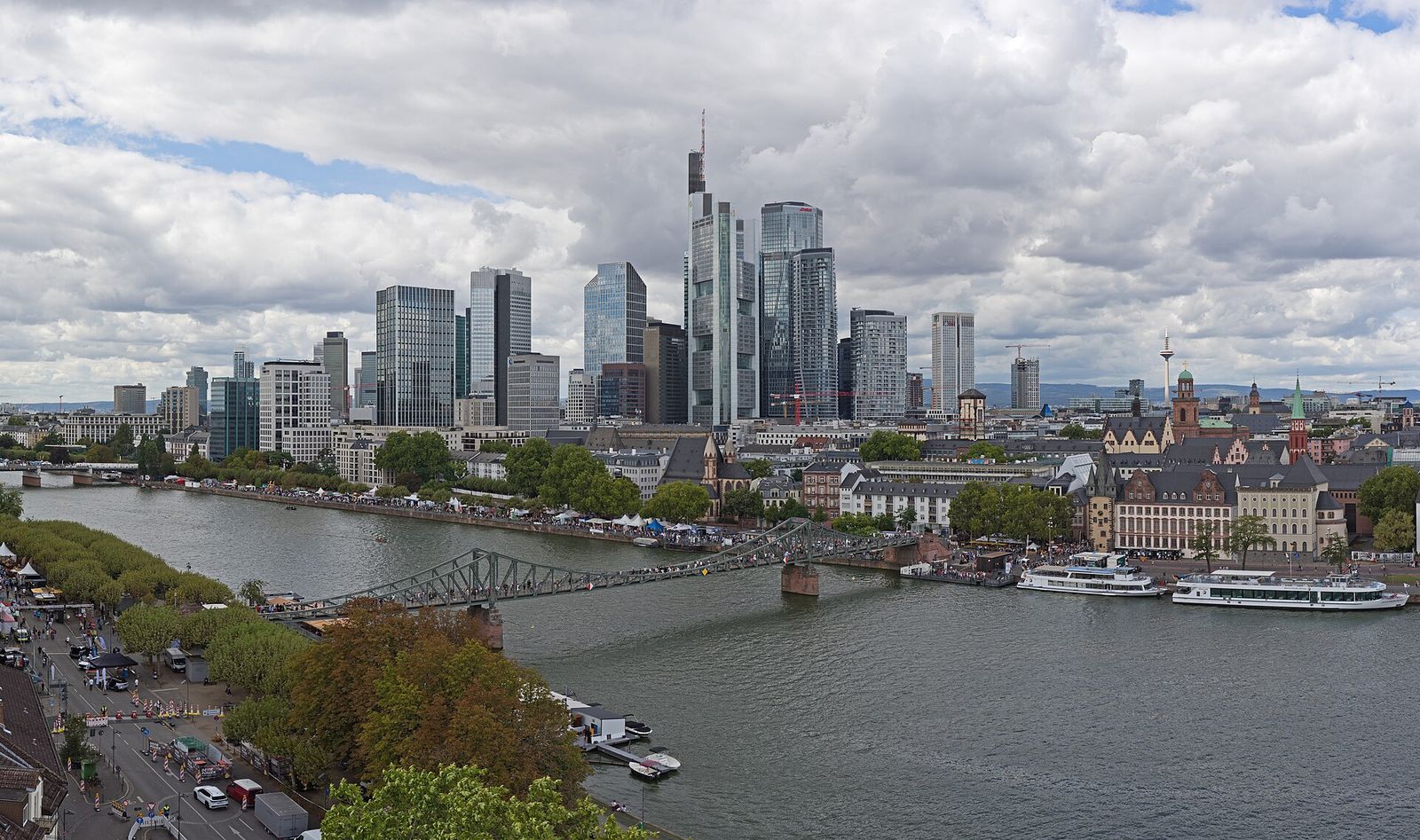
Frankfurt's banking district. Photo: Jörg Braukmann, via Wikimedia Commons, CC BY-SA 4.0 (licence)
A September 2026 report from Market Data Forecast (MDF) estimates the European cyber insurance market at US$1.51 billion in 2025, with an estimate of US$1.77 billion for 2026 and a forecast of US$5.47 billion for 2034. These are the research company's estimates and forecast, not observed industry-wide totals. The report covers multiple European countries, including the UK, Germany, France, Russia and Turkey.1
A separate assessment from Munich Re puts European cyber insurance premiums at US$3.3 billion in 2024, representing 21% of global premiums in its estimate. The two companies therefore publish materially different numbers. MDF labels its figures as market size while Munich Re explicitly reports gross premium volume; their definitions and methods should not be assumed equivalent.1,2
The principal market figures
| Measure | Published figure | Source / period |
|---|---|---|
| Europe market size, 2025 | US$1.51bn | MDF; 2025 estimate |
| Europe market size, 2026 | US$1.77bn | MDF; 2026 estimate |
| Europe market size, 2034 | US$5.47bn | MDF; 2034 forecast |
| Annual growth, 2026 to 2034 | 17.12% | MDF; reported CAGR |
| Europe premium volume, 2024 | US$3.3bn | Munich Re; 2024 estimate |
| European renewal rate change, Q2 2026 | -9% | Marsh; client portfolio |
The difference between these measures is central to reading the market. Total premium volume measures insurance premiums written; a renewal-rate index measures the price change experienced by a particular broker's client portfolio; a market-size forecast follows the definition used by its research provider. None is a direct substitute for another.1,2,3
What the growth projection actually says
MDF's published values imply that the market would be just over three times its estimated 2026 size by 2034. Its report states an annual compound growth rate of 17.12%. Calculating compound annual growth directly from its two published endpoints, US$1.77 billion in 2026 and US$5.47 billion in 2034, over eight years produces approximately 15.15%. The reason for this numerical difference is not established in the public report. The figures are reproduced here as published rather than silently adjusted.1
The projected expansion is an estimate of future aggregate market value. On its own it does not establish that an individual business will face higher insurance premiums, that claims will rise at the same rate, or that insurers' profits will increase.
Where the report places the fastest growth
| Segment | MDF projected annual growth |
|---|---|
| Healthcare end users | 21.2% |
| Small and medium-sized enterprises | 19.1% |
| Solutions component | 17.7% |
| Packaged cyber insurance policies | 15.4% |
These percentages apply to different classifications and should not be added together. MDF identifies the financial services and insurance sector as its largest end-use segment in 2025, while projecting the fastest end-use growth in healthcare. It identifies large enterprises as the largest buyer category in 2025, but forecasts faster growth among SMEs. Stand-alone policies are reported as the dominant insurance type, while packaged policies are projected to expand by 15.4% annually.1
The distinction between market share and growth rate is important. A smaller segment can grow faster without becoming the largest. The public report does not provide the absolute euro or dollar market values for each of these segments, so the size of the projected increase in each category cannot be independently calculated from those percentages alone.
Which countries account for the market?
MDF attributes 24.4% of its estimated 2025 European market to Germany, placing it first in its country assessment, followed by the United Kingdom. Applied mechanically to MDF's US$1.51 billion European total, a 24.4% share corresponds to approximately US$368 million; this is an arithmetic illustration, not a separately published German market estimate.1
The report also discusses France, the Netherlands and Sweden, but the public summary does not give equivalent country market shares for them. It is therefore not possible to construct a reliable country ranking or European country-by-country market table from this source alone.
Why falling prices do not contradict an expanding market
Marsh reports that European cyber insurance renewal rates fell 9% in Q2 2026, the eleventh consecutive quarter of decreases in its index. It describes insurance capacity as available and coverage as remaining broad. Marsh states that its index reflects the composition of its own client portfolio, rather than every European cyber insurance transaction.3
This differs from MDF's description of tightening capacity and sharply rising premiums. The reports are using different evidence and measurements, but the public materials do not provide enough detail to reconcile their accounts fully. A decline in the price charged at renewal can coexist with growth in the overall market if the number of insured customers, the coverage purchased or other factors change. The sources do not quantify how much each factor contributed in Europe in 2026.
How much of the market remains uninsured?
Munich Re describes a substantial cyber insurance protection gap globally, with much cyber exposure still uninsured. Its 2025 research notes the limited history of loss data and the challenge of modelling risks that can affect many businesses through shared technology dependencies. Neither its published global protection-gap discussion nor MDF's summary supplies a single directly comparable percentage of all European businesses holding cyber insurance in 2026.2,4
This is relevant to interpreting SME growth forecasts. A forecast of 19.1% annual growth in the SME segment does not itself reveal the proportion of European SMEs currently insured, the number of new policyholders expected or the typical size of their policies.
What the figures establish, and what remains uncertain
Across these sources, the consistent observation is that cyber insurance is an established commercial insurance category, with European market activity measured in billions of US dollars. MDF forecasts expansion through 2034, Munich Re records substantial European premium volume in 2024, and Marsh observes lower renewal rates among its European clients in mid-2026.1,2,3
The uncertainties are also material. The headline market valuations differ across providers; MDF's stated annual growth rate is not reproduced by its published endpoints; the public report lacks absolute values for most of its segments; and the latest broker renewal data does not align with its description of rising prices. Those limits do not invalidate the figures as reported, but they constrain what can reliably be concluded from them.
Taken together, the numbers describe a market with different trends in total estimated value, customer segments and insurance pricing. They do not establish a single undisputed measurement of Europe's market size or provide a basis for predicting how individual businesses' premiums or insurers' financial results will change.
Calculation note: the independently calculated annual growth rate is (5.47 / 1.77)^(1/8) - 1 = 15.15%. Other market figures are reported without recalculation unless explicitly identified as an arithmetic illustration.
Corrections: none. If you spot an error, tell us and we will correct it openly.